
One little dot at the end of a sentence stands as a foundational block in our understanding of punctuation. From a young age, we’re taught how to put the pieces together and this one mark will wrap everything up. Nevertheless, much like the rest of the punctuation world, period usage is more complicated than just trying to signal when a message is finished. The more we add in different tools, different tones, and different purposes, usage isn’t easily predictable. Throughout this article, we’ll work with the more complex and confusing scenarios that appear in daily writing. Using well known guidelines from Associated Press Stylebook (AP) and the Chicago Manual of Style, you’ll find trusted answers for those complicated sentence endings.
Let’s dive right in.
Indirect questions

Indirect questions can lead to confusion on the punctuation front, they aren’t quite statements and not entirely questions. Luckily, AP Style Guide can provide answers. Since an indirect question isn’t a full question, then it takes a period at the end instead of a question mark. As you can see here, the question is indirect since it is a retelling and not the original source.
Rhetorical questions

Rhetorical questions are dealt with in a similar way. These questions specifically work more like statements. Think of it in conversational terms, you never answer a rhetorical question. Therefore, the lack of a question mark doesn’t influence anything.
In relation to quotations

If you’re dealing with question marks and periods, it’s easy to fall into a back and forth debate. Nevertheless, AP and Chicago provide clear answers. When quotes are used at the end of a sentence, the ending period belongs inside the quotations. As you can see in the example, the period inside the quotations doesn’t only end the quote but the entire sentence.
In relation to parentheses

The other main cause of confusion happens with parentheses. This explanation is a little more complicated than just what side the mark falls on. In this specific example, an independent sentence is enclosed and while the context relates to the overall message, it doesn’t entirely rely on the first sentence. By the rules of Chicago and AP, the mark goes inside to end the enclosed statement.
The exception
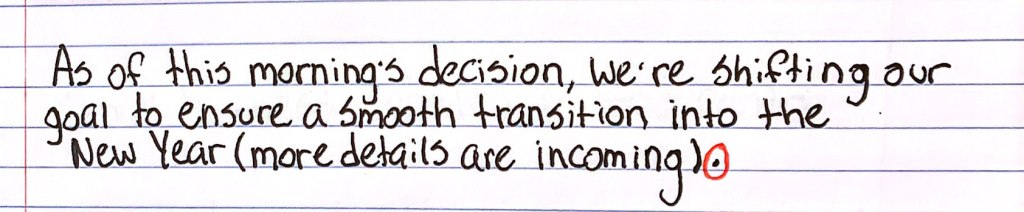
On the other end of the parentheses, Chicago says when a fragment or a full sentence are enclosed within the outer sentence, then the mark goes outside of the closing parenthesis. Look at this example, we’re technically dealing with a full sentence. However, the context of the main sentence keeps the two pieces related and it becomes a part of the whole message. Even though the sentence could stand on its own, the entire context is tied to the first sentence.
Ellipeses
Before Condensation

After condensation

Everybody knows ellipses in the sense of hesitations or showing unfinished thoughts. In the more professional usage, ellipses are meant to signal when sections or words have been left out from the original text. This practice is defined by AP Style as condensation. You might see condensation in quotes of speeches or long texts to show the sections that only relate to the main point. However, AP warns against getting too comfortable with this tool, overuse could lead to distorted meanings and do more harm than good. When ellipses are used in AP style, the form is three stacked periods with one space on each end. In Chicago style, ellipses look like three spaced out periods. Here, looking at the two different forms of this memo, you can see that the ellipses in the second example took out one sentence that had nothing to do with the main purpose.
Where periods are omitted
Titles

Aside from sentence types, there are a number of fragment pieces that influence period placement. Titles, in this case a book title, never take a period at the end. That standard is why you don’t see periods at the end of movies, books or any other titled works. *Note: the underline in this sentence is a signal for italics.
Headlines

The title rule also extends to headings and things that act like headings, such as headlines, column heads in a table, and phrases used as captions. Headlines don’t quite make up grammatically complete sentences and therefore, following guidelines, there is no period involved.
Addresses

When dealing with addresses, there are cases where periods are involved, but that is more to do with the abbreviations that can happen. For this particular example, there is no abbreviation since the word street is required to be spelled out in this case. Due to that condition, there is no period setting the address apart.
Ending in abbreviations

Speaking of abbreviations, the distinction between period or no period can be tricky. The definitive answer depends on the abbreviation. For this sentence, there is no need for an added period to close off the message, since the abbreviation for United Nations already has one. Chicago says to avoid a double mark in these circumstances.
 McDonough Editorial
You must be logged in to post a comment.